How to Fold an RV Cover So It Goes Back On Easily
Fold an RV cover loosely and in a repeatable order, with its clean inner surface protected and straps gathered. This makes the cover easier to store and unfold when you put it back on.
On this page (8 sections)
- How do you fold an RV cover step by step?
- Should an RV cover be dry before folding?
- How do you keep straps and buckles from tangling?
- Which parts should you check before folding?
- How should you fold a cover with access panels or vents?
- How do you store the folded RV cover?
- How can you make the next installation easier?
- What is the easiest way to fold an RV cover?
Fold an RV cover loosely and in a repeatable order, with its clean inner surface protected and straps gathered. A dry cover with its corners and access panels oriented consistently is easier to store and put back on.
Before folding, check the cover maker's instructions for its storage method. Covers differ in their fabric, straps, panels, and included storage bags, so use a method that doesn't pull on seams or force zippers.
How do you fold an RV cover step by step?
Dry, clean, orient, fold, and store the cover without crushing its fabric or hardware. Having a second person help with a large cover can keep it off the ground and reduce dragging.
- Remove the cover carefully, loosening straps and buckles instead of yanking them.
- Let the cover dry fully, inside and out.
- Shake off loose leaves and dirt, then check for damage.
- Lay it out with the inner surface protected from the ground.
- Fold both sides toward the center, keeping panels and straps orderly.
- Fold or roll from one end into a bundle that fits the storage space.
- Store it in a dry place, away from sharp objects and pests.
The goal is a bundle that opens in a useful order next season. Don't make tight creases at corners, windows, or reinforced areas just to force the cover into a small bag.
Should an RV cover be dry before folding?
Yes, let the cover dry completely before long-term storage. Damp fabric packed tightly can hold moisture against itself and develop a musty smell.
If the cover is dusty, follow its care instructions before cleaning it. Avoid harsh cleaners, high heat, or vigorous scrubbing unless the maker allows them.
Choose a dry, shaded area with enough space to spread the cover. Check both sides, especially seams and folds, and wait until they no longer feel damp.
If you found moisture inside the RV after covering it, first look at airflow, fit, and the weather conditions. Our guide to whether RV covers trap moisture explains why a cover alone doesn't prevent condensation.
How do you keep straps and buckles from tangling?
Gather straps as you take the cover down, and keep each one with its buckle or attachment point. Loose straps can snag fabric, twist around one another, or make the next installation slower.
Coil each strap loosely and tuck it between folds, away from zippers and sharp hardware. Don't cinch straps around the fabric bundle; pressure in one place can create a hard crease.
If you use a separate tie to hold the bundle together, choose a soft one that won't cut into the material. Keep any metal clips or hooks from resting against the cover fabric.
Can gust straps help hold a cover in place?
A gust strap can help secure a cover, but use it only where the cover's design allows. The Lucky Straps set is made for car covers, so check compatibility before considering it for an RV cover.
The set includes screw-tight clips and bungee cords with hooks. The cords are under tension, so handle them slowly and keep them away from your face and hands.
Don't attach clips to an RV cover unless its instructions permit that attachment method. For cover-specific wind management, see how to put a cover on an RV, which explains fitting and securing the cover.
Which parts should you check before folding?
Inspect seams, corners, straps, buckles, and zippers before storing the cover. Finding a small tear or loose strap now gives you time to address it before the next installation.
Brush away debris without pulling at a snag. If you find a puncture, use a repair method made for the cover fabric; our guide to patching a torn RV cover covers the repair decision.
Close zippers only as the cover instructions direct. Keep tension straps relaxed and avoid folding a buckle into the fabric where its edge could rub or press during storage.
How should you fold a cover with access panels or vents?
Keep zippers and vent panels from landing under a sharp fold or heavy buckle. These features can help with access and airflow while the cover is installed, but they also need care during storage.
For example, the RVMasking 20-22 ft cover has zippered side panels, a rear panel, and vents. Fold it so those areas lie flat, and keep straps clear of zipper pulls.
The cover also includes reinforced corner patches and a repair patch for minor tears. Keep the reinforced areas from bunching into a tight lump in the stored bundle.
Choose a cover that matches your RV and its access needs before thinking about storage convenience. Our guide to the best material for an RV cover explains fabric and fit considerations.
How do you store the folded RV cover?
Keep the folded cover in a dry, clean place where nothing sharp or heavy can damage it. Use its storage bag if one is included and the cover is dry enough to pack.
Don't store it against fuel, solvents, or equipment with exposed edges. Keep it off a damp floor, and avoid stacking heavy items on top of the bundle.
If the cover is too large to fit neatly, use a larger breathable storage space rather than forcing it into a tight container. Letting the fabric rest without hard compression helps prevent difficult creases.
Does the cover's size affect how easy it is to fold?
Yes, a cover that's difficult to handle is harder to fold neatly. Choose a cover sized for your RV, then lay it out on a surface large enough to manage its length and width.
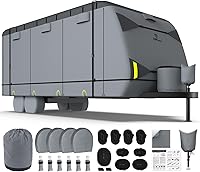
VINPATIO's 20-22 ft cover is designed for travel trailers in that length range. Its accessory kit includes a storage bag, and the brand recommends padding sharp edges during installation.
Measure your RV according to the cover maker's sizing instructions before choosing a size. For help with the installation sequence, read how to put a cover on an RV.
How can you make the next installation easier?
Fold the cover in the same orientation each time and leave straps accessible. That gives you a familiar starting point instead of an unmarked bundle of fabric.
If the cover has a front label or distinct front panel, place that end on the outside of the bundle. Keep the first panel you'll need to unfold easy to reach, and don't bury buckles under several layers.
Store any included instructions with the cover. On the next installation, work from the roof outward and follow the cover's directions for attaching and tensioning its straps.
What is the easiest way to fold an RV cover?
The easiest method is to dry the cover, gather its straps, fold the sides toward the center, and roll or fold it loosely from one end. Keep zippers, vents, and buckles from forming hard pressure points.
Pick a cover that fits your RV and store it where it can stay dry. For choosing between cover types and fit, start with what makes the best RV cover.
Frequently asked questions
How do you fold an RV cover for storage?
Let it dry, remove loose dirt, and lay it out with the clean inner surface protected. Fold the sides toward the center, gather straps without sharp bends, then loosely roll or fold from one end.
Follow the cover's instructions if they give a specific method.
Should an RV cover be wet when you store it?
Store an RV cover dry whenever possible. Moisture trapped in a tightly packed cover can lead to musty odors or mildew, so let it air out fully before folding.
If you must take it down while damp, spread it out to dry as soon as you can.
How do you keep RV cover straps from tangling?
Gather each strap as you remove the cover, keeping it attached to its matching buckle or tie point. Coil loose lengths gently and secure them with a soft tie, then place them inside the folds so they don't snag or drag when you unfold the cover.