Are RV Covers Waterproof?
Some RV covers are waterproof, while others are water resistant and better suited to moderate climates. A waterproof label does not guarantee a dry RV if water enters through seams, openings, or a poor fit.
On this page (8 sections)
- Are RV covers waterproof or water resistant?
- What makes an RV cover repel rain?
- Can rain get through seams, vents, or zippers?
- How does cover fit affect rain protection?
- Which RV cover should you choose for rain?
- How can you keep an RV dry under a cover?
- Are waterproof RV covers a good choice for winter?
- Which cover should you choose?
Some RV covers are waterproof, while others are water resistant and better suited to moderate climates. A waterproof label does not guarantee a dry RV if water enters through seams, openings, or a poor fit.
The right choice depends on your weather, how long the RV will sit outside, and how well the cover fits. Look at the fabric and coating, but also check the seams, straps, vents, and edges that could rub against the cover.
Are RV covers waterproof or water resistant?
Some RV covers are labeled waterproof, and others are water resistant. Those terms describe different levels of water protection, so check the cover’s materials and intended conditions before choosing one.
For example, RVMasking describes its travel trailer cover as waterproof and gives a 2000 mm water column rating. ADCO describes its Aqua Shed cover as water resistant and designed for moderate climates with high moisture.
Those descriptions help you compare covers, but they don’t tell you how every cover will perform in your particular weather. Rain intensity, wind, fit, wear, and moisture below the cover all affect the result.
If you want to compare cover materials and construction, see our guide to the best material for an RV cover.
What makes an RV cover repel rain?
The fabric and its coating help determine how water moves across a cover. Dense fabric and a water-repellent coating can limit water penetration, but rain protection also depends on seams, openings, fit, and condition.
RVMasking’s cover uses 600D Oxford fabric on top, 300D material on the sides, and a PU coating. FRUNO describes its Class C cover as made with 300D Oxford fabric on top, 150D Oxford on the sides, and a dense PU coating.
ADCO’s Aqua Shed has a triple-layer SFS AquaShed top panel and triple-layer polypropylene sides. ADCO describes the cover as water resistant and intended for moderate climates with high moisture.
Fabric weight alone doesn’t settle which cover is right for you. Compare the cover’s water protection and intended climate, then check that its design fits your RV.
Can rain get through seams, vents, or zippers?
Yes, water can enter through openings or worn areas even when a cover’s fabric repels rain. Inspect seams, zippers, and edges, especially after heavy rain or strong wind.
Vents support airflow, but they are openings in the cover’s design. RVMasking describes six vents on the sides and ends, and FRUNO describes multiple air vents for circulation and moisture control.
Zippered panels also create areas to inspect. RVMasking has roll-up side panels and a rear zipper panel; FRUNO has four rollable panels.
Close the panels as designed when you don’t need access, and check their condition during routine inspections.
A cover that shifts in the wind can rub against protrusions or expose areas of the RV. For fit and installation details, read how to put a cover on an RV.
Do RV covers need vents if they are waterproof?
Vents can help air circulate under a cover, which may reduce trapped moisture. Waterproof fabric by itself doesn’t prevent damp air from collecting around a covered RV.
Cover a dry RV, secure the cover as instructed, and inspect the RV after rain. If you find moisture underneath, check the fit and ventilation, and look for worn fabric or areas where water may be getting in.
For more on trapped moisture and cover use, see whether RV covers work or trap moisture.
How does cover fit affect rain protection?
A cover should match your RV’s type and measurements so it can be secured without excess slack. A poor fit can leave areas exposed or allow the cover to billow and rub in wind.
Measure the RV according to the cover’s instructions, including protrusions where required. FRUNO says to include the bumper, ladder, and spare tire in its measurement, but exclude the hitch.
Check each cover’s own measuring instructions because sizing methods can differ.
Secure the straps and tension points as directed, then check for contact with sharp edges. FRUNO advises covering or padding sharp edges with towels, rags, or foam pads to help prevent wear.
For a closer look at fit, airflow, and the reasons covers can cause moisture problems, read Do RV Covers Work, or Do They Trap Moisture?.
Which RV cover should you choose for rain?
Choose based on your climate, RV type, and need for water protection. The three covers below have different materials and stated water resistance, so match those details to your storage conditions and measurements.
RVMasking: for a travel trailer and a stated waterproof rating
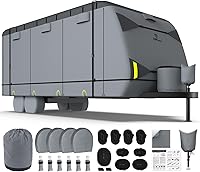
RVMasking is a travel trailer option with a stated 2000 mm water column rating. It has 600D Oxford fabric on top, 300D material on the sides, a PU coating, and six vents.
Choose it if that size range and its travel trailer design match your RV. Check the required length and the cover’s instructions before ordering.
ADCO Aqua Shed: for moderate climates with high moisture
ADCO’s Aqua Shed is a water-resistant travel trailer cover designed for moderate climates with high moisture. It has triple-layer top and side panels, plus built-in vents and a buckle cinching system.
Choose it if your RV fits the stated length range and your storage conditions suit a water-resistant cover. It is a different choice from covers described as waterproof.
FRUNO: for a Class C RV and waterproof protection
FRUNO describes its Class C cover as waterproof and uses 300D Oxford fabric on top, 150D Oxford on the sides, and a PU coating. It includes multiple vents, adjustable straps, and an elastic hem.
Choose it if the cover’s Class C design and size range fit your RV. Measure carefully and protect sharp edges before installation.
How can you keep an RV dry under a cover?
Start with a dry RV, a correctly sized cover, and secure straps. Then check the cover and the space beneath it after rain or wind.
- Follow the cover’s measuring and installation instructions.
- Pad sharp edges that could rub against the fabric.
- Secure straps and tension points so the cover stays in place.
- Keep vents and closures in their intended positions.
- Inspect fabric, seams, and zippers for wear.
- Check beneath the cover for moisture after wet weather.
A cover can’t fix an RV leak or replace checking its roof and seals. If you find water inside, inspect the RV as well as the cover to locate where it is entering.
Are waterproof RV covers a good choice for winter?
A waterproof cover may suit a wet winter, but fit, airflow, and weather conditions still matter. Choose a cover intended for your RV and expected climate, then check it regularly while the RV is stored.
Snow, wind, and long periods outdoors can put more stress on a cover and its straps. Clear snow only as the cover’s instructions allow, and inspect for sagging, shifting, or contact with sharp edges.
If you’re deciding whether seasonal coverage makes sense, read Should I Cover My RV in Winter?.
Which cover should you choose?
If you want a cover described as waterproof, compare RVMasking’s travel trailer cover and FRUNO’s Class C cover against your RV’s type and measurements. If you store a travel trailer in a moderate, high-moisture climate, ADCO’s water-resistant Aqua Shed is another option to consider.
Check the cover’s water protection, climate guidance, fit, and ventilation together. Then inspect the RV beneath it after rain so you can catch moisture or wear early.
Frequently asked questions
Are RV covers completely waterproof?
Some covers are labeled waterproof, while others are water resistant. Neither label guarantees a dry RV in every storm or storage setup.
Check the fabric, coating, seams, fit, and ventilation, and protect sharp edges that could wear through the cover.
Is a water-resistant RV cover enough for rain?
A water-resistant cover may suit moderate climates, depending on how often and how heavily rain falls where you store the RV. Check the cover's intended climate and construction, then inspect the RV after rain to see whether water is getting through.
Can a waterproof RV cover cause moisture inside?
Yes, moisture can collect beneath a cover if airflow is limited or damp air is trapped. Look for vents and a fit that allows air to circulate, and make sure the RV is dry before covering it.
What matters most when buying a waterproof RV cover?
Match the cover to your RV's type and measured length, then compare its water protection, seams, straps, and vents. A close fit helps limit billowing, while vents support airflow.
Check for sharp edges and cover them before installation.