How Much Is a RV Cover?
A RV cover usually costs a few hundred dollars for a travel trailer and more for a big rig. Fabric, size, layers and included accessories move the price most.
On this page (10 sections)
- What changes how much a RV cover costs?
- How much should you budget for a travel trailer cover?
- Which RV cover gives the best value for a travel trailer?
- Does a cheaper cover save money in the long run?
- Are straps and patches worth adding to the budget?
- Does cover material change the cost that much?
- Where should you spend more and where can you save?
- Should you cover your RV in winter, and what does that cost?
- Which brand is worth the money?
- What's the bottom line on RV cover cost?
A RV cover usually costs a few hundred dollars for a travel trailer and more for a big rig. Fabric, size, layers and included accessories move the price most.
The honest answer is a range, not one number. A thin one-layer cover costs the least, and a thick multi-layer cover with tire covers and straps costs the most.
Where your RV parks and how long it sits decide which end of that range makes sense.
What changes how much a RV cover costs?
Size and materials drive the price first. A 26 to 28 ft travel trailer cover uses less fabric than one built for a 40 ft fifth wheel, so it usually costs less.
Layers are the next factor. A 9-layer non-woven cover with an anti-UV composite and a water-repellent outer coating costs more than a basic single-layer sheet.
The RVMasking cover is a good example of that heavier build.
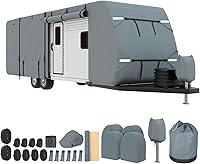
What comes in the box matters too. A kit with tire covers, a propane tank cover, a tongue jack cover and gutter spout covers saves you buying those parts one by one.
A bare cover often needs straps sold separately.
Finally, where you buy and whether the cover is custom-fit versus universal-fit changes the total. Custom covers cost more and fit tighter.
How much should you budget for a travel trailer cover?
Plan for the mid-range for a camper trailer cover, and treat the cheapest option as a short-term fix. A few hundred dollars is a fair working figure for a decent travel trailer cover.
Spend less only if the RV sits under a roof most of the year. Spend more if it parks outside through snow, sun and wind.
The savings on a cheap cover show up as repairs later. A tear along a sharp corner or a ladder edge lets water in, and that's where a patch kit earns its keep.
Add a small buffer for straps and patches when you set the budget. Those extras cost little and extend the life of whatever cover you buy.
Which RV cover gives the best value for a travel trailer?
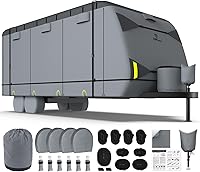
The RVMasking 26-28 ft 9-Layer Travel Trailer Cover is the best value pick for a travel trailer because it bundles the extras most buyers add anyway. It's a true heavy-duty cover built from 9-layer non-woven fabric with 4% anti-UV composite.
The wind setup is where it earns its keep. Two over-roof straps, an extra-long horizontal strap that wraps the bottom, plus front and rear tension panel straps keep it snug.
Bottom windproof straps and an elastic hem finish the fit.
It protects 8 corners with extra-long reinforced patches, which cuts the risk of punctures from sharp edges. The rear corner patches are raised to guard against ladder edges.
The kit includes 4 tire covers, a propane tank cover, a tongue jack cover, 6 gutter spout covers, 2 weighted toss metal sticks, a repair patch and a step-by-step manual.
Ventilation comes from 8 vents on the sides and ends. There are 3 zippered roll-up side panels for interior checks and loading, plus a rear zipper panel suited to toy hauler trailers.
Does a cheaper cover save money in the long run?
Usually not if the RV sits outside in wind. A thin cover that flaps tears sooner, and replacing it twice costs more than one thicker cover.
The money question has two parts: the cover and the repairs. A budget cover plus a patch kit plus new straps can drift close to the price of a better kit.
If you park in a mild, sheltered spot, a basic cover is a fine spend. For snow, sun and coastal wind, the heavier fabric is the cheaper choice over several seasons.
Check seams and corners before the season turns. Patching a small hole early with the Camco kit is far cheaper than buying a replacement.
Are straps and patches worth adding to the budget?
Yes, if the cover you pick doesn't include them. Straps keep the cover from billowing, and billowing is what tears fabric.
The RV MURTS 2PCS RV Cover Tie Down straps are 40 ft by 1.5 in with adjustable POM cam buckles. They're made for lashing covers down on RVs, trailers and boats, not for lifting or suspending a load.
The Camco ULTRAGuard RV Cover Patch Kit measures 9 by 72 inches and sticks on with no tools. It's designed for the top panel of Camco ULTRAGuard covers, so check that match before you rely on it.
Budget a little for these if your cover arrives bare. They're small line items next to the cover itself.
Does cover material change the cost that much?
Yes, it's the single biggest driver. The best material for an RV cover balances breathability, water repellency and UV resistance, and each of those adds cost.
A breathable middle membrane lets damp air out on sunny days. A water-repellent outer coating makes rain bead and roll off.
A UV composite slows sun damage to the fabric.
Thin single-layer fabric skips most of that. It costs less and protects less, and it tends to fail at the corners first.
Read our guide to the best material for an RV cover before you compare prices, because two covers at the same size can be very different builds.
A waterproof claim is worth checking too. Our post on whether RV covers are waterproof explains the difference between water-repellent and truly waterproof fabric.
Where should you spend more and where can you save?
Spend on fabric and fit; save on accessories you already own. A tight-fitting multi-layer cover protects better than a loose premium one.
Pay for reinforced corners, secure straps and a breathable membrane. Those three things decide how long the cover lasts.
Save by buying a universal-fit cover in the right size instead of a custom one. Measure the RV length first, then match it to the cover's stated range.
Save on accessories if you already have tire covers, or if the kit includes them like the RVMasking set does. Don't pay twice for the same part.
Skip upgrades you won't use. A rear zipper panel only helps if you need to load bikes or gear through it.
Should you cover your RV in winter, and what does that cost?
Covering in winter can pay for itself if the RV sits under trees or snow. The cover keeps leaves, sap and ice out of seams and roof fittings.
The question of whether to cover in winter depends on your climate and storage. Our guide to whether you should cover your RV in winter walks through the trade-offs.
The cost is the cover plus the winter prep around it. If the RV stays outside, a good cover is cheaper than roof and seal repairs.
If you store indoors, a light dust cover may be all you need, and that costs less. Match the spend to the exposure.
Which brand is worth the money?
Compare brands by fabric layers, strap design and included parts, not by name alone. The best RV cover brands publish those details clearly.
Our guide to who makes the best RV covers compares the main names on those points. Use it before you settle on a brand.
A well-built cover from a smaller brand can beat a weak cover from a big one. The specs tell you which is which.
Check the warranty length too. It's a fair signal of how confident the maker is in the fabric.
What's the bottom line on RV cover cost?
So how much is a RV cover? Expect a few hundred dollars for a travel trailer and more for a big rig, and add a little for straps and patches if your kit is bare.
Spend more on fabric and fit, and save on parts you already own.
The RVMasking 26-28 ft cover is the value pick for a travel trailer because it bundles tire, propane and jack covers with heavy-duty straps. Add the Camco patch kit for small tears and the RV MURTS straps if you want extra hold.
Measure your RV first, match the size to the cover's range, and check the corners and straps before the season starts. That keeps one cover doing the job of two.
Frequently asked questions
Is a cheap RV cover worth it?
A cheaper cover can work for short storage in mild weather, but thin fabric tears faster in wind and sun. If your RV sits outside all winter, a thicker multi-layer cover usually lasts longer.
Do RV covers come with straps and tire covers?
Some do and some don't. Complete kits like the RVMasking set include tire covers, a propane tank cover, gutter spout covers and a repair patch.
Budget covers often sell the straps separately.
How long does an RV cover last?
A good multi-layer cover can last several seasons if it fits snugly and you patch small tears early. Thin one-layer fabric and loose straps shorten life by letting wind whip the cover.
Can I use a tarp instead of a cover?
A plastic tarp traps moisture and can scuff paint, so it's a short-term fix at best. A breathable RV cover lets damp air escape while it keeps rain and dust off.
Why does the size change the price so much?
A bigger cover uses more fabric, more seams and heavier straps. A 26 to 28 ft travel trailer cover uses less material than one built for a 40 ft fifth wheel, so it usually costs less.